Egypt, when activists turn on journalists

Amidst all the turmoil in Egypt, one aspect may have by-passed the casual observer. Foreign reporters and commentators have become targets for the ire of some of the very same activists, bloggers etc. who supported the ‘coupvolution’ that deposed Mohamed Morsi and who say that they stand for human rights, democracy and freedom of expression. It has given rise to such choice blog headlines as ‘Fuck Western Media’. These critics seem to be irate at correspondents not completely buying into their own line of reasoning. From mild charges of ‘misrepresentation’, the accusations at times veer into the realm of conspiracy theory. With the press and foreign correspondents under attack anyway in Egypt, we really don’t need that from the supposed democratic part of the commentariat. I have published a piece on it on openDemocracy.

Just to show that I’m not the only one noticing this trend among activists, here’s a tweet by a Swedish journalist on a similar phenomenon. He draws a straight line from how the party of Hosni Mubarak, the NDP, and then the Muslim Brotherhood, the MB, used to address foreign reporters to what he hears nowadays:

I don’t want to single out any activist, blogger or tweeter and many seem to have moderated their views as the situation has unfolded. Also, many of the online attacks on the media come from more conservative sources who probably used to be aligned to the Mubarak regime and now have thrown in their lot with the mass protest movement and the army. Still, whatever the practical contingencies, that’s not fit intellectual company for those who champion freedom. This is not about muzzling the critics of the Western press but it’s about not fanning the flames of incitement at a time when reporters get physically assaulted, arrested, intimidated and worse.

(Probably not) the final word on the war correspondent’s dilemma

Here’s a very considered, courageous and deep-digging inquiry into the question of why war correspondents do what they do.

PODCAST – Diary of a bad year: A war correspondent’s dilemma – NPR’s Kelly McEvers

And more at transom.org It is infinitely more complex, sophisticated and inquisitive than my short blog post on the subject. I wonder if there’s anything left to say. Then again, everybody has a slightly different story.

An evening on Tim Hetherington – and all I took were some lousy phone pics

More musings on conflict reporting – my conflicted view

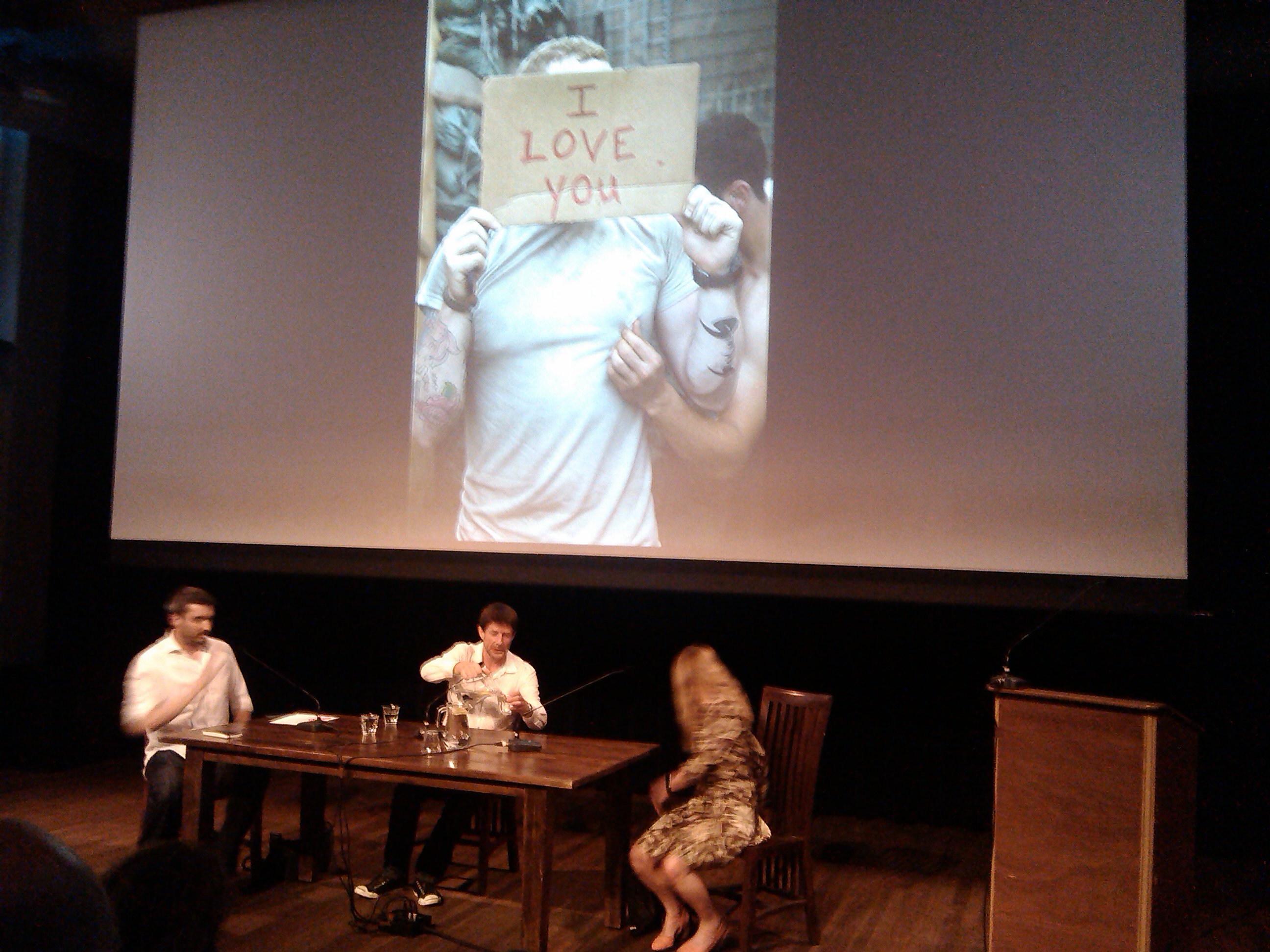
Stephen Mayes, director of the estate of Tim Hetherington, talks at de Balie in Amsterdam

Tim Hetherington was a wonderful photographer and documentary maker who operated mostly in conflict zones, which on 20 April 2011 got him killed in Misrata, Libya. The Arab Spring, so hopefully named, has been particularly deadly and otherwise damaging for those covering it. An exhibition of Tim’s work arrived in Amsterdam in July and a new film on his life, a tribute directed by Sebastian Junger with whom he made the 2010 award-winning documentary Restrepo on life at an American outpost in Afghanistan, also had its Dutch premiere…


Various friends of Tim’s attended the launch and gave presentations that I won’t go into; I want to talk about me and Tim. I never met Tim, never heard of him before Restrepo and only vaguely afterwards. But we had a few things in common, apart from rugged good looks (I wish). We both did journalism courses in the UK and we both ended up in war zones. I know it’s not much but it’s more than some. Yet when I listened to the presentations and as I watched the film, the gulf between our experiences seemed vast, making me question the way I engaged with some of the same topics that Tim came across. There was a charming bit in which he has to talk about what it is that he’s doing. He starts out with a rather worthy description, only to stop himself short and say “that’s bullshit”. More attempts follow before he gets it right, kind of. It feels like it’s meant to show the difficulty war reporters have in talking about their work without sounding pompous, full of pathos and bravado or, on the other hand, overly jaded. But it can also be seen as defanging any such qualms pre-emptively as in, ‘see, he knew how difficult it was to talk about it’. Yet he talked about it a lot, on camera and on the record…


It always makes me feel uncomfortable. I have not heard people talk about war reporting in public in a way that sits well with me, probably reflecting a puritan streak that urges me: do, don’t tell. I find it almost impossible to talk about my decade or so covering conflict in a way that does not somehow trivialise it, dramatise it or worse, instrumentalise it for my own greater glory. When I sometimes try to discuss it, as dispassionately and in as sparse and stripped-down terms as I find possible, it feels as if nobody listens. Poor me. It is as Tim also said: you need to communicate in order for people to be able to engage with the subject. But I feel utterly conflicted about people who continue to communicate such issues outside the context of immediate war reporting. In the film on his life, many also said of Tim that he was always engaged with his subjects, the people he came across, whom he kept treating as individuals, as human.

Stephen Mayes, James Brabazon and Max Houghton talking about Tim Hetherington at de Balie, Amsterdam
James Brabazon, James Brabazon and Max Houghton talking about Tim Hetherington at de Balie, Amsterdam

Expressing such engagement also makes me somewhat uncomfortable. Maybe there’s a big difference between writers and photographers, also in the levels of danger encountered and in the way they process what they see, but I find the exhortation to keep in mind that the people you write about or photograph are also human, individuals with their own stories and not just characters in a larger plot, utterly redundant and preposterous. The cliché that war reporters only write about cannon fodder or people as numbers, is misleading and tiresome. Overwhelmingly, reporters who risk their lives, who insert themselves knowingly into dangerous situations, are very much aware of the excess of humanity around them. Human yes, always interesting? No. War and conflict tend to polarise people, resulting in a couple of standard narratives that many of those involved and engaged in conflict employ. It is a reporter’s job, maybe not a photographer’s, to puncture those shells and dig down to the real story if there is such a thing. Combat may temporarily heighten one’s senses but continual conflict flattens everything, including what distinguishes people. After a while, all stories become similar, whether it’s an American soldier’s or an Iraqi Jihadist’s. The logic of violence is often frighteningly similar and therefore also horribly clichéd. Yes, it is ritualistic and it has to do with male bonding but to me these themes never held the fascination they seemed to have had for Tim Hetherington. Perhaps that is at the root of much of my unease; I have always been a reluctant war reporter with a visceral distrust of people who sought out such situations willingly. Just maybe the life and work of Tim Hetherington will start me thinking differently about such things. But I’m a hard nut to crack.

I yet have to see Tim Hetherington’s show ‘Infidel’ at Foam Amsterdam and may post on this again afterwards…

Art, conflict and pretty pics – Nat Muller on Richard Mosse’s The Enclave

Poster for The Enclave, Irish Pavillion, 55th Venice Biennale
The poster for The Enclave at the 55th Venice Biennale. On the back Lac Vert Lullaby. A text at the bottom said that it was recorded by Ben Frost at Lac Vert, Congo, in 2012 for The Enclave.

“Artists do not per se have an accountability towards their audiences. If anything their accountability is to make interesting work”

Nat Muller, independent curator and critic with her share of experience  in conflict areas and former conflict areas such as the Middle East and the Balkans, shines her light on Richard Mosse’s The Enclave, shown in the Irish pavilion at the 55th Venice Biennale. She reacts to my doubts about a work that straddles the divide between art and photojournalism, and more directly to the criticism by Louise Williams, the Irish journalist with extensive experience in Congo. You can follow Nat and Louise on twitter: @nat_muller and @Loureports and Louise has a blog: travels with my microphone

All in the Assad Family

I Love Bashar in English, Arabic and Camel

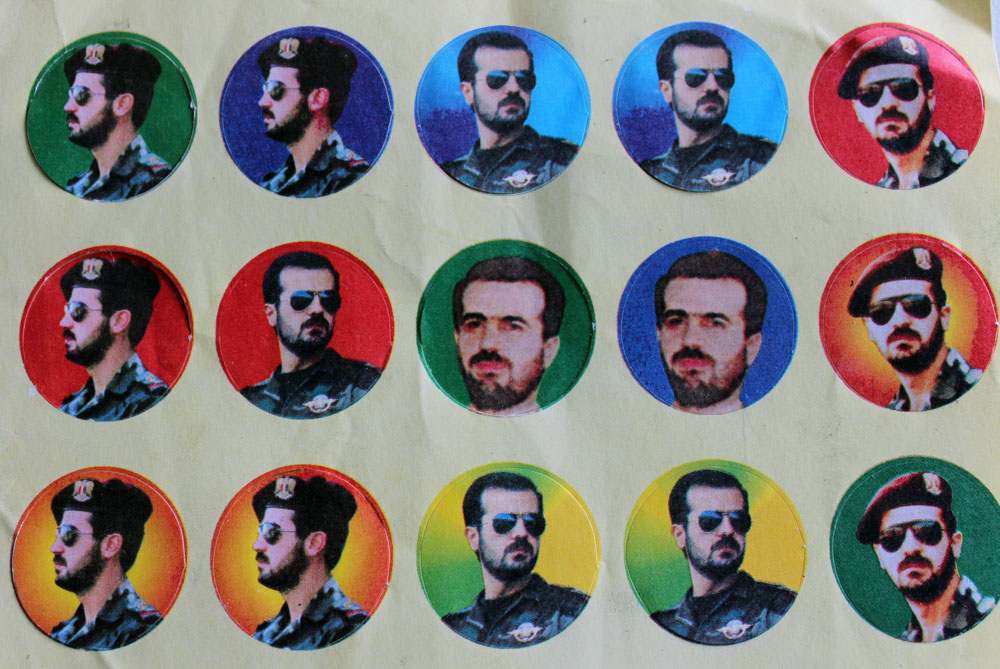
Come on, who doesn’t love Bashar? Well at least his Assad family paraphernalia. Sure, this is not government issue and he has eschewed the statues and huge portraits that his father, Hafez, so enjoyed. Syria’s ruling house has been somewhat middle of the road in its self aggrandisement when compared to some of its neighbours. Jordan’s Hashemites shouldn’t have to go for the farcical, full-bedouin dress or operetta-military outfit propaganda pics, being descendants of the prophet but they do anyway. And remember the giant stone busts of fellow Baathist dictator Saddam Hussein at his Baghdad palace? Still, the Assads have been cultivating their image as a ruling family for decades, as in this button from the 1990’s depicting Hafez with his son Basil, his intended heir who died in a car crash, and Bashar who had to be given legitimacy quickly.

Hafez, Basil and bashar, The Assad family's, hence Syria's, Holy Trinity
Hafez, Basil and bashar, The Assad family’s, hence Syria’s, Holy Trinity

The text at the bottom boldly declares ‘Suria al-Assad’ as if another push towards more complete identification of the family with the country and vice versa were necessary. But it’s a lovely tradition in the region to name your country after your family. The Saudis did it and Jordan is also the Hashemite Kingdom. Anyway, to understand the particular mess that Syria is in today, it helps to know a couple of things about the Assads, apart from the whole Alawite angle. Bashar was never intended to lead the country, his older, more dashing and martial brother Basil was the heir apparent. He took a ‘special interest’ in neighbouring Lebanon that extended to him dating a beautiful Lebanese girl – ironic detail: after he died, she married a Lebanese politician and newspaperman who was killed years later in what many belief was Syria’s campaign against its opponents in Lebanon.

The dashing Basil Assad - groomed for greatness, died in a car crash
The dashing Basil Assad – groomed for greatness, died in a car crash

Bashar, the gawky supposed medical doctor and ophthalmologist was roped in to rescue the family franchise, leading to the by now well-known list of blunders on his part, starting with a ruthless crackdown on even the mildest of dissidents following a very brief ‘spring’ when he took over in 2000, then the fiasco in Lebanon where his henchmen are widely suspected of being behind the assassination of Rafiq Hariri in 2005 and culminating in the brutal actions against peaceful demonstrations in 2011 that led to the current civil war. While on the subject of blunders: Those awful Sunni Jihadi terrorists that he accuses of forming the bulk of the opposition, well they are to a large degree his own creation. Syria used radical Islam on many occasions against its enemies, including the well-documented sluicing of men and money to Al Qaeda in Iraq, the very same group that’s now causing so much trouble in his own ‘Suria al-Assad’. Blowback or what?

Obviously Bashar paraphernalia is so much less cool than Basil’s and Hafez’s. They are both buried in a mausoleum in Qardaha, the birthplace of the Assad clan that sports a large statue of the pater familias in the town centre. Bashar may end up in foreign soil, if things continue this way. I have more Hafez and possibly some Bashar stuff stored somewhere and will try post the gaudiest items if I ever dig them up.

Bosnia’s invisible Saudi

Saudi man cutout

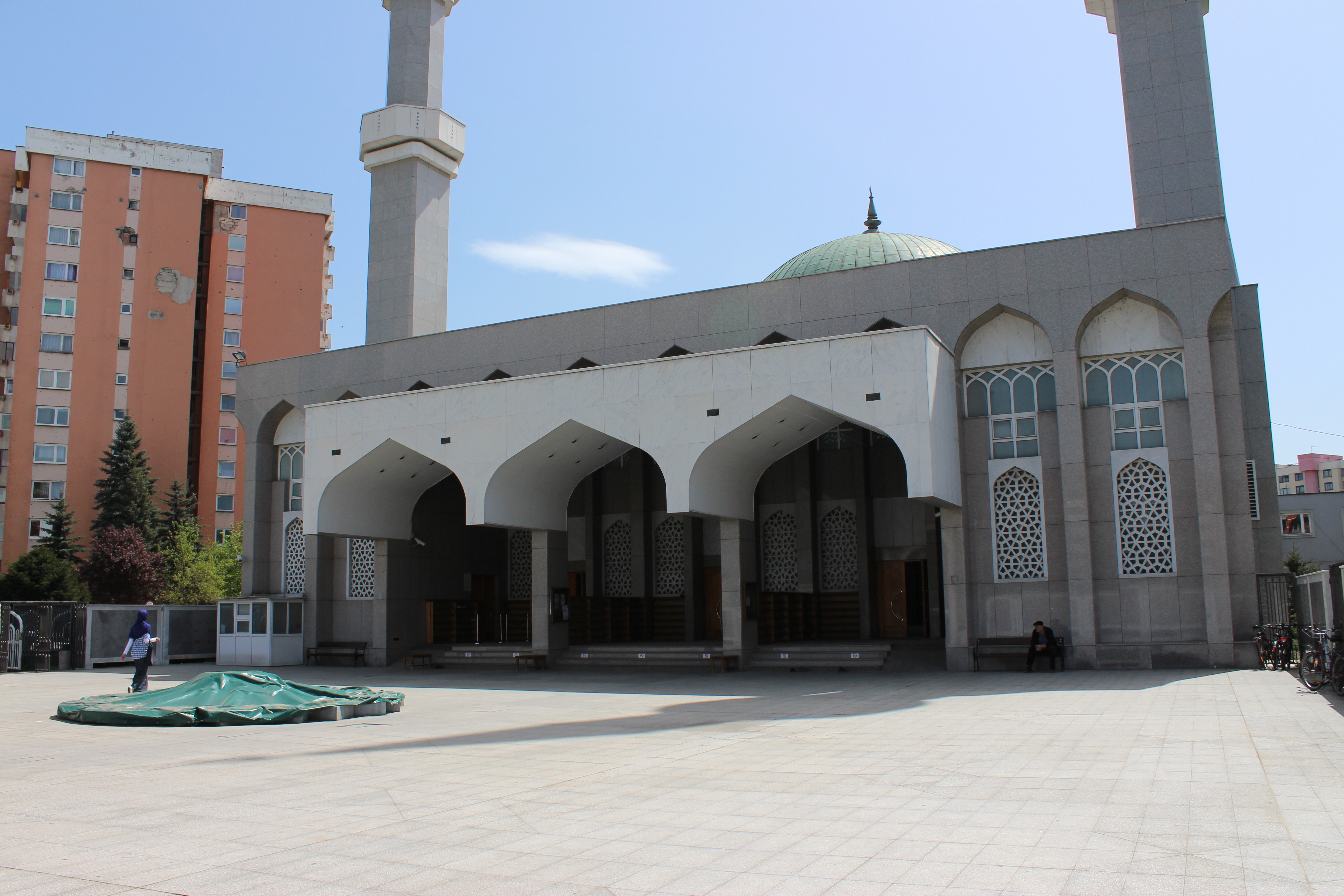
Meet the invisible Saudi, he resides at the King Fahd Bin AbdulAziz Alsaud cultural centre in Sarajevo, adjacent to the largest mosque on the Balkans, a gift from Saudi Arabia to the people of Bosnia after that country’s devastating war in the 1990’s. A prop used by the cultural centre during a book fair to get Bosnians better acquainted with Saudi society, the invisible Saudi and his equally invisible wife (but that is not uncommon in Saudi Arabia) could be a symbol for that country’s role in Bosnia. During the war, rumours were rife of Saudi funded foreign Jihadis joining the ranks of Bosnia’s besieged Muslim community in their fight with mainly the Orthodox Christian Serbs. Concern over these supposed Jihadis using Bosnia as a jumping board into Europe and the US kept cropping up periodically for more than a decade after the war and received new impetus after 9/11. But the story has since died a silent death. One local journalist and analyst in Sarajevo who wrote about it repeatedly, recently told me that it has become a non-issue. Steps that were taken to deal with it have proved adequate and the threat never panned out. With global concern over Jihadis in Syria reaching fever pitch, it may be a very small example of how worst-case scenarios are not always realistic.

Saudi Cutouts

Much more revealing about the present moment in the Middle East than the whole Jihadi question was an unprompted remark by the Saudi cultural representative in Sarajevo concerning Iran. Asked about Turkey’s unquestionable cultural influence in Bosnia, he said, “Turkey and Saudi Arabia are the same in Bosnia. Only some other countries are against us. Yes, Iran”. European Bosnia may not seem an obvious place for the raging sectarian tensions that plague the Middle East to surface but maybe the official had in mind the expulsion of four Iranian diplomats accused of spying that was rumoured to be taking place as he was speaking.

IMG_0164
The Saudi-built King Fahd Bin AbdulAziz Alsaud mosque in the Alipasino Polje neighborhood of Sarajevo, the Balkan’s largest.

Many Bosniaks, the name for Bosnian Muslims, are not that charmed by either Iran or Saudi Arabia, which a group of youngsters having coffee on a Friday morning in the shade of the looming Saudi mosque in the Alipasino Polje neighborhood of Sarajevo lumped together as “the East”. Ignoring the call to Friday prayer, the law and business students at the café expressed their disapproval of “all that Wahhabi stuff, veils, religion in the street, that we never had before the war.” Yet they did not see a major Jihadist problem in Bosnia either. “We are European, not like those Muslims of the East.”

Gazi Husrev-bey Mosque
The invisible Saudi nipping out for prayer at the Ottoman era Gazi Husrev-bey Mosquein central Sarajevo

The Bosnians have plenty of their own problems to worry about without importing new ones from Turkey, Saudi Arabia or Iran. The sectarian and political mess that persists almost two decade after the war is leaving them behind in the former Yugoslav republics’ drive to join the EU. The corruption, bloody mindedness and astonishing obtuseness of their political leaders has led to such high-farce crises as the babies born in bureaucratic limbo and a national museum closed for lack of a national narrative. Even though a virtual EU protectorate and boosted by Islamic and European goodwill and aid, Bosnia is an object lesson in how civil war and sectarian divisions can screw a place up for years to come.

Bosnia National Museum closed

Creative Commons License
Bosnia’s invisible Saudi by Ferry Biedermann is licensed under a Creative Commons Attribution-NonCommercial-NoDerivs 3.0 Unported License.

Congo in Green (and Pink)

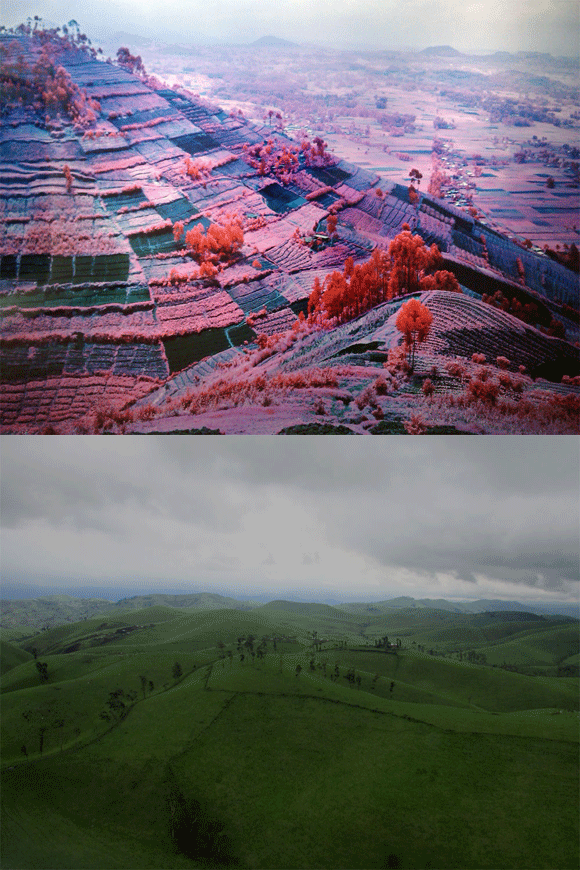
Congo-in-Pink-and-Green

Congo in Green and Pink is the way I intended the artwork for the interview With Louise Williams to come out but the animation did not work for that. So here it is, just to get the idea. The pink one is a pic of Richard Mosse’s photo and the green one is Louise’s.

Art, journalism and conflict – Louise Williams on Congo pictures

Interview with Louise Williams on Congo, conflict and the pictures of Richard Mosse

More on the pitfalls of art, journalism and conflict – A while ago I posted on Richard Mosse’s impressive work on Congo for the Irish pavilion at the Venice Biennial, called The Enclave. The work is troubling in part because it situates itself so clearly in a war zone and uses that, to the extent that the texts at the show mentioned a new way of looking at photojournalism. My Irish friend and colleague Louise Williams frequently visits Congo for her work as a journalist and a trainer. And she is fed up with the one-dimensional perpetuation of this violent image of Congo and with people using it towards their own ends. Listen to the interview (10 minutes). The artwork is supposed to be animated, fluctuating between pink and green. I posted it separately. 

Creative Commons License
Louise Williams on Richard Mosse and Congo by Ferry Biedermann is licensed under a Creative Commons Attribution-NonCommercial-ShareAlike 3.0 Unported License.

The Act of Killing

From Congo to Indonesia, doubts about the depiction of conflict

Coincidence? I think not. The main character in The Act of Killing, the documentary movie that is being promoted in the above trailer, is called Anwar Congo, a notorious Indonesian warlord who massacred communists in the 1960’s. I saw this problematic film hot on the heels of viewing the art documentary/installation on militias in Congo at the Irish pavilion at the Venice Biennale. My question then as now was: Is it exploitative, does it glamourise conflict? For me, the jury is still out on The Enclave, Richard Mosse’s Congo project, although a Congo-going friend and colleague outspokenly thinks so. But I have no such doubts about Joshua Oppenheimer’s The Act of Killing. I find it tilting the wrong way, not just because of the deeds of Anwar Congo but because of the filmmaker’s choices. As a journalist, I sympathise with the difficulty involved in bringing horrendous stories to the attention of a larger public. But in this case, I feel that a line has been crossed and that, very much in the spirit of this age, storytelling veers into self-aggrandisement (And yes, I realise the irony of making such an accusation on a blog, the ultimate engine of self-promotion). The numerous times that the killer, Congo, directly addresses the filmmaker by name, Joshua this, Josh that, is in itself revealing. I assume that it could have been easily edited out. After all, Joshua has seven years worth of material. The most problematic part of the movie is the ending when a money shot sequence of Congo retching in regret offers the kind of redemptive finish that would make even a Hollywood exec blush. Joshua tries to play it cool and inoculate himself against charges of pandering by pointing out to Congo that his victims felt a lot worse than he does re-enacting their suffering – this is after all just a film while they knew they were going to die. The regretful retching comes after that, though, and goes on for quite a while. Together with the ambivalence of the rest of the movie, it leaves a bad taste in the mouth. It feels cheap and empty. If Congo really feels bad, what are the consequences? Does he kill himself? Does he ask his victims for forgiveness? Does he give himself up to be tried for war crimes? And if not, why do we not see him leading his life as if nothing happened? I wonder if this as either a lazy choice by the director or an easy melodramatic device. As it stands, it gives the impression of at least partial redemption for a mass murderer and as such confirms my unease about the rest of the movie. But yes, like The Enclave, it’s beautifully shot.

Zombies in ireland

image

My friend and former Middle East colleague Ed O’Loughlin, who has successfully reinvented himself as a writer, has turned his gory attention to his home country Ireland. It’s zombies! and it’s innovative: you can pay to have your name appear in the book, check it out:

http://www.edwardoloughlin.com/all-you-can-eat/